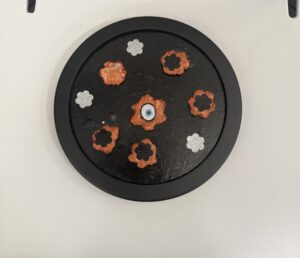
Thought Wheel

Ann Chiappetta

Playing with Stencils

| Filed under blindness

“Celtic”

4 x 6: acrylic on canvas.

The artwork is rectangular with a deep red or burgundy background. It features an ornate Celtic-style knot design in the center, rendered in gold/yellow and black colors. The interlaced pattern is symmetrical and decorative, with flowing curves and loops characteristic of Celtic knotwork. The are is framed in split wood dowels to give it a rustic and mystic accent.

One of the first tools I found helpful in my journey of mixed media and collage art is the stencil. It is a balance of preciseness while being forgiving. It’s like the adult version of not being afraid of drawing outside the lines. I also found a few tricks along the way. I tape the stencil down, and if needed, use copy paper to help keep the surface free from errors.  When a good image reveals itself once the stencil is peeled away, it’s like being a kid on Christmas.


There are also plenty of sloppy or poor images. I keep some of them for other collages for background and layering.


As for the stencils, any craft store, online or physical, will have a wide selection and most are sold in themed packages in many sizes. I would suggest starting with simple stencils first no larger than 5 x 7 inches and begin with acrylic markers and use medical gloves, as you will end up with ink and/or paint on your fingers.


If you do not like wearing gloves, have wet wipes handy, you will need them. If you want to start, just do it. Practice,  and let your creativity flow.

The Visual Artist Who Can’t See 👀

| Filed under blindness

I am asked how I make visual art without the benefit of sight. Being a writer and artist who is blind does not always mean I create alone. I am a collaborator, I get a surge of personal satisfaction when a group project succeeds, receives positive feedback or receives praise and recognition. It is larger than me, honors the hard work, insight and forethought of others.


Sometimes, though, I get stuck or run up against a barrier I cannot navigate when I am working solo. When it happens, I open my networking space and search for an answer. It could be a group, organization, small group or a good friend or colleague agreeing to assist me. My sister, Cheryll, is the photographer responsible for most of my book covers. I describe my idea and she sorts through her expansive catalog to find the right image. Other times I cast a line out to a wide audience, like when I wanted feedback on an article about blindness, low vision and participating in a choir.  If you would like a copy of the article, email me at president@friendsinart.org .


In terms of my mixed media and collage art, I get assistance with trimming, gluing and orienting myself. If you want to know where to buy various sizes of paper punches, including one that resembles a jigsaw puzzle piece, I am your gal.:)


I ask my family for the simple things like making sure I have the right color of paint or paper.  I use the Be My Eyes app for sighted assistance and AIRA is another subscription-based video call assistant app I use when accuracy is important, like for photos of my work. I use a product label scanning app called Seeing AI to identify a product, then mark it for easier identification. I use what is called RFID labels from a company called HABLE. The app is called SpeechLable. The adhesive stickers can be scanned and record a spoken description and saved to the app.


Jerry and April both assist with hot gluing because I like my fingerprints. 🤕🤕

Another ask is to assist me when choosing paint pens in the vast assortment I have acquired over the years. For some reason AI is not good at this unless I use white paper and draw on it for a color analysis. It is easier and faster to just ask a person. I still have not produced a reliable way to keep the fifty or so acrylic markers and gel pens sorted by color.


Things I do not need help with encompasses about 95% of my art-making and  framing and 98% of my writing. I do have a few trusted writers who love to help me with simple tasks like checking my poem is left-justified or formatted according to a journal’s guidelines if I am stuck.

Creating happens in a internalized, cerebral bubble but taking it outside the dome is invigorating. It builds my confidence.  I began collage with small panels and over time, expanded the size to 18 x 24 canvas boards. I started simply, then grew with the experience.

I gravitate to intimate art pieces but hope to grow with the process.


Visit my gallery:

https://www.annchiappetta.com/whispering-vines-studio


Wood wall art featuring a black bird accented in yellow and orange on a green lefy background in a dark wood frame.


🪼

My Artist’s Journey of Discovery

| Filed under blindness

A Mixed Media Journey


I am Annie. This is my journey of getting back into painting,abstract and collage art after thirty years. Going blind meant saying so long to visual arts, or so I thought. Now that I am retired and exploring new things and renewing my connection to the arts, I am inviting you to come with me.


It will be messy and my work might make you scratch your noodle, but it is my hands, fingers, and imagination expressing who I am that will hopefully resonate with you .


To view my gallery, visit

https://www.annchiappetta.com/whispering-vines-studio/

All my pieces are tagged with alt text for the blind and low vision visitors.

The first piece is  called “Swirl” It is one of my larger pieces, measuring 18 x18”.I used heavy weight watercolor paper, a stencil, acrylic paint and stamps. It is my statement to the labyrinth and Celtic designs.

What I learned from making this piece: purples and magentas compliment green nicely, stamping is much more precise and better quality than twenty years ago, and trying to get the stencil to release from the paper after I let it dry too long made me groan with frustration.


Each piece I’ve made has taught me to be patient, prepare and think about the statement I want to convey visually, and do my best not to be hard on myself when I do mess up.

Until next time –

The artwork features a buttercream and gold  shimmer paint background.  The circular labyrinth contains curved lines in green and magenta at the center, resembling a stylized maze. Surrounding these lines are eight large and small black, simple leaf  shapes scattered  along  the white space. The edge resembles a lace fabric design.


Word for the Day is Go 🦮

| Filed under blindness Guide dogs

The word for today in Annie’s world is “GO”.  We went on our first walk with the dogs since the bad weather set in last November. Iowa did a great job leading the way. He was eager to go, and I needed to go for health reasons. Jerry and May also got going.


The obstacles we avoided thanks to Iowa’s guidance included two large sewer grates, a parked car, a few passing cars and one stop sign controlled intersection.


Iowa and I did have a conversation as to when to cross over to the driveway of our house. He wanted to begin a bit too early. I wanted a more direct line.  Let’s say we compromised, my husband laughing as we negotiated.

I said,

“Forward,”

Iowa went a few steps, then would stop and look right at the house. Jerry said we weren’t opposite yet.

We repeated this dance until Jerry judged we were aligned and I got the okay to go.


If Iowa had his way we would have angled and I would lose my bearings.

Jerry said I shouldn’t be so perfectionistic, Iowa knew where to take us.


The lesson for the day, go with your dog.


New art in Whispering Vines Studio

| Filed under blindness

Please visit Whispering Vines Studios – Ann Chiappetta


and check out two new mixed media art pieces. Galaxies is a 12″ x 7″ unique abstract polychromatic acrylic on canvas. Desert Night is an 11″ x 14″ acrylic and stencil desert scene accented with genuine snakeskin.


The purchase price includes shipping.


Please contact me with questions.

Happy Holidays!


Touchable Art Show ‍

| Filed under blindness

Hello friends and neighbors –

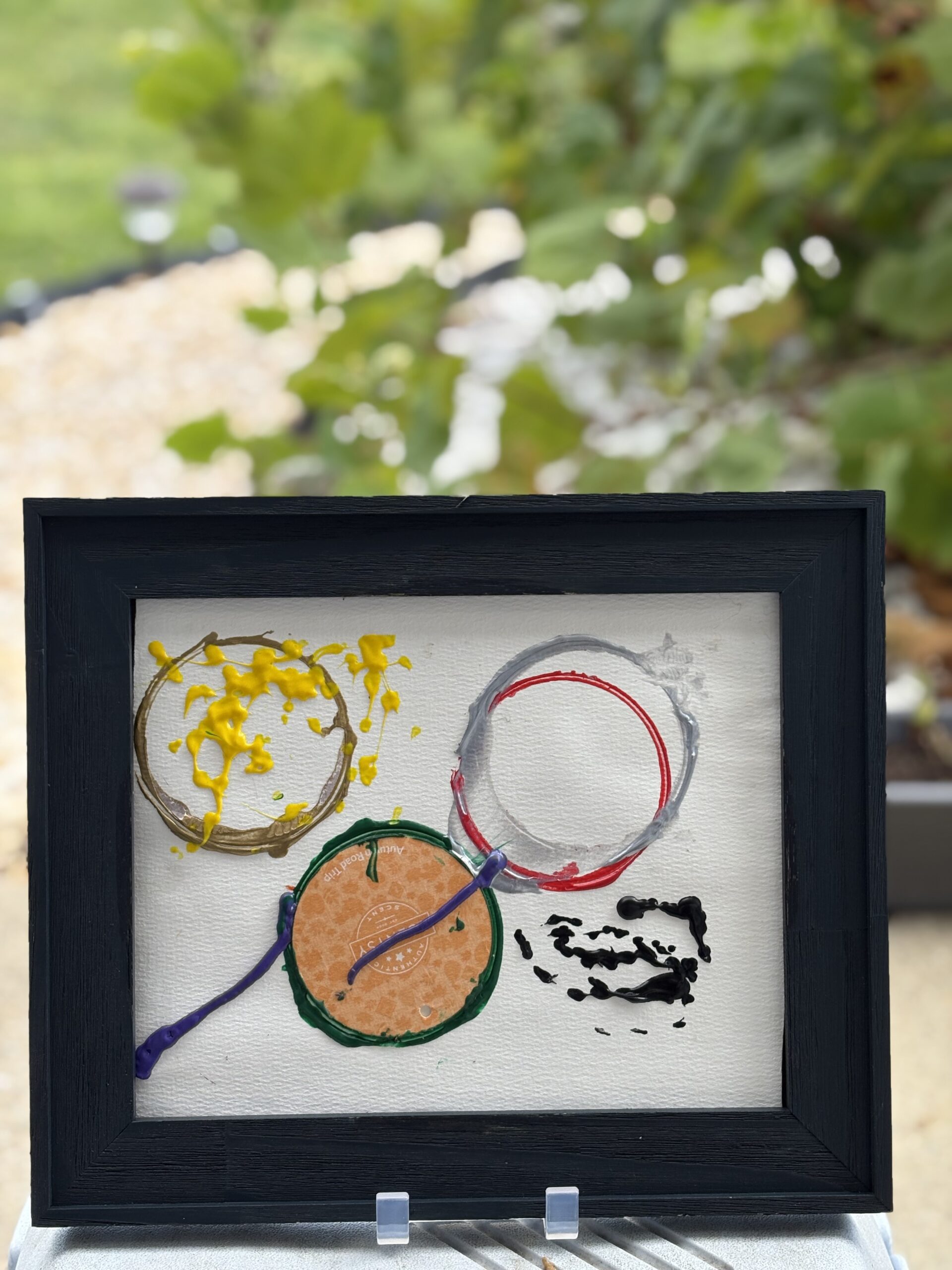
One of my art pieces will be on display, along with 33 other touchable sculptures by artists at the Somatosensory art show at the Carnegie Library of Accessible Media for Pennsylvanians, or LAMP. The opening is Friday, November 7 from 4:30 – 6:30 p.m.

I’d love for you to attend opening night and explore all the pieces of touchable and accessible art. This event is unique to the art community, as most visual art is not able to be appreciated with the sense of touch, a vital frame of reference to individual with visual impairments or other sensory barriers.


Here is the address:

the Carnegie Library of Accessible Media for Pennsylvanians.

4724 Baum Blvd.
Pittsburgh PA 15213

To learn more about the Somatosensory exhibit, call

412.687.2440 or 800.242.0586

Web: LAMP/Library of Accessible Media for Pennsylvanians – Carnegie Library of Pittsburgh


The web address to my virtual gallery is:

www.annchiappetta.com/whispering-vines-studio/

I hope to see you there!

Annie

Phot is an abstract framed piece of wall art in yellow, red and black circles on a white background. It resembles a messay bar top.

/

White Cane Safety Day 🧑‍🦯

| Filed under assistive technology blindness Guide dogs

🧑‍🦯

Celebrating International White Cane Day

My white cane means being able to travel safely. It tells the public I am blind. Using it gets me places and tells others I am just as deserving as the sighted to experience life.


Below is more on the worldview.

The World Blind Union (WBU) marks International White Cane Day by reaffirming the cane’s role not only as a tool for safe and independent mobility, but as a universal symbol of pride, dignity, and the right to inclusion for blind and partially sighted people everywhere.

At a time when diversity and inclusion efforts face renewed challenges across many parts of the world, the white cane stands as a powerful reminder that blind people belong in every aspect of community life. It represents visibility, identity, and the ongoing pursuit of equal rights.


On this International White Cane Day, the World Blind Union calls on governments, policymakers, and communities worldwide to:

  • Guarantee accessibility in public infrastructure, transport, and digital spaces.
  • Safeguard and strengthen legal protections for the rights of persons with disabilities.
  • Recognize the white cane as a universal symbol of independence and inclusion.

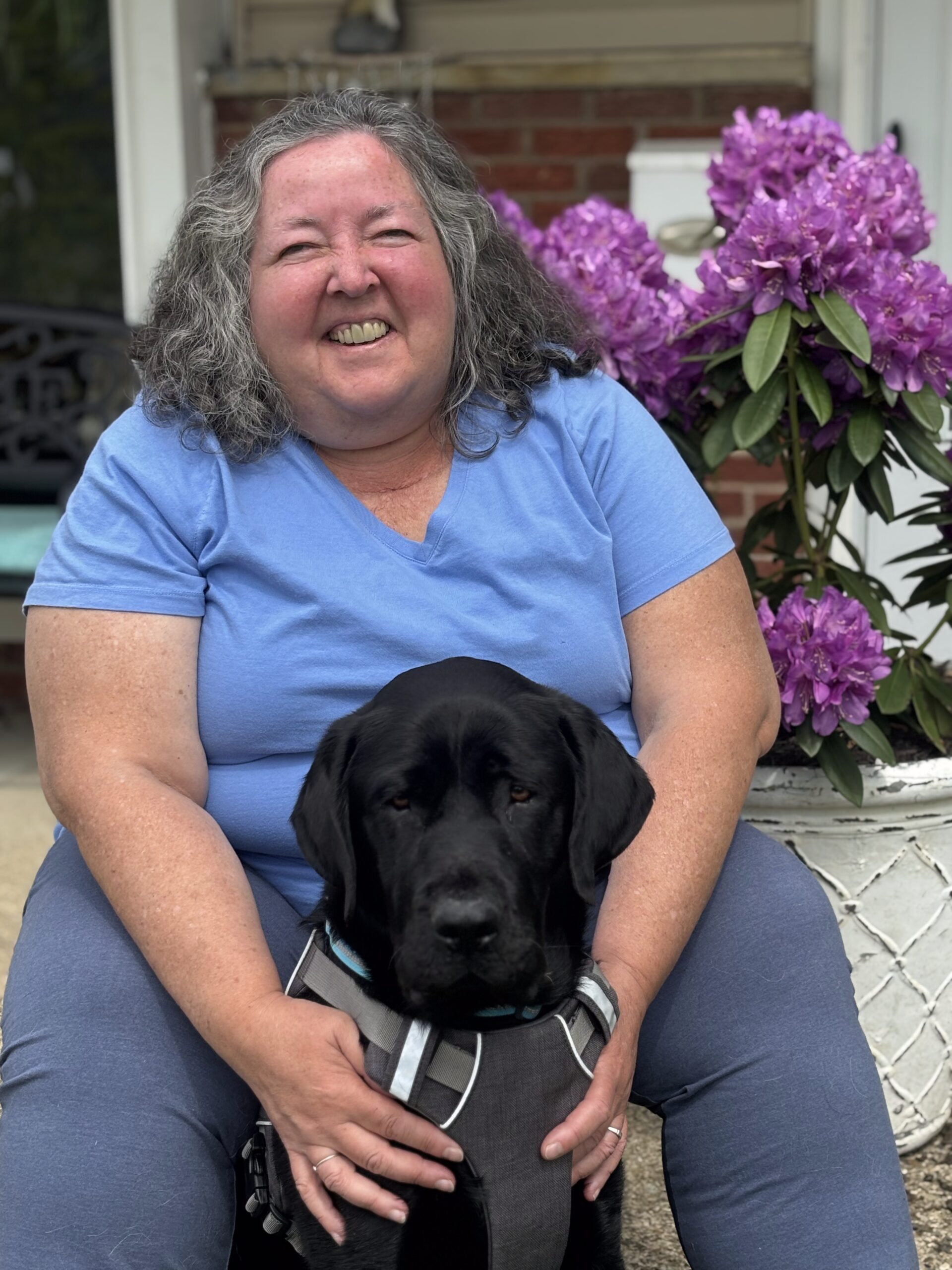
Annie, a light skinned mature woman with curly shoulder-length gray hair sits with her new guide dog, a black lab named Iowa. They are posed in sitting position beside a red-purple flowering rhododendron. She and Iowa are looking into the camera and Annie looks happy and relaxed, a big smile on her face.

Are You Afraid of the Dark? 🎃

| Filed under blindness nonfiction writing

Is a Blind Person Afraid of the Dark?

by Mark Carlson

As a kid I was, like a lot of kids, afraid of the dark. I used to have a lamp on the dresser in my bedroom that I kept on all night. It was definitely a product of the 1960s, very modern and made of orange plastic and about the size of a football.  That light was as much a talisman against the demons of the night as a practical way of finding the door and bathroom in the dark. I could never sleep without that light on all night, and Mom knew it.

But one night, I guess I was about twelve or so. I remember thinking, “It’s too bright in here. I’ll try turning off the light”.

So, I did. It was easier than I would have thought, and just like that I fell asleep in total darkness. For the rest of my life I slept soundly in the dark. In fact, any light at all sort of bothered me. If there was light in the hallway outside my room there was a strip of light under the door, and that actually bothered me. Over the years I came to realize that I preferred it to be totally dark at night. I kept my curtains close to keep the Moonlight or the pale glow from the street from interfering with my sleep.


Now, decades after turning off that tacky orange light, I still sleep in darkness. But the reason is different. I have no choice. I am totally blind, and every night is as black as pitch. And so is every day, even at high noon. I live in perpetual darkness, with no more light entering my eyes than if I was in a stygian black coal mine. It took some time, at least a decade, to get used to the world growing dimmer and less distinct every day, and of the slowly encroaching and permanent night. So I sleep in the dark all the time, even if I take a nap in the middle of the afternoon.

It does get kind of weird, as when I know there is a light left on somewhere in the house. Perhaps I had a friend over for the evening and forgot to turn it off. It’s funny, but since I never turn on any lights in my home for my own benefit, I have to do it for my sighted friends. As I like to say, “You sighted people are slaves to light.”


When out and about, I am more comfortable at night, even more so than when I had sight. I feel safer, somehow, as though the cloak of darkness envelops me in a shroud of invisibility. I know that is silly, but its true. Since I don’t depend on my eyes to perceive the world around me, I can do in the dark what most people need light to do.

In other words, I see perfectly in the dark.


But there is a downside to being blind. I still have a fear of the dark. Even in my sixties, grown up and all, independent and logical, And knowing full well there is nothing in the  dark that wasn’t there in the day, I sometimes find it hard to sleep. I can close my eyes and open them, with absolutely no difference between the two states. I know what is in my bedroom and house, and in a pinch, can get up and go wherever I need to go with total confidence and safety. I am talking about sleeping in the dark. That is when the dreams take over.

I have very vivid and realistic dreams. I dream in color with almost total recall of what I dreamed. Every sound, smell, taste, touch and of course sight is clear and detailed. In my dreams I am totally sighted. But since so many of my dreams involve some of my hidden phobias, I can’t prevent them from visiting me in the night.  Everyone has phobias and fears. Some people are afraid of heights, or being in crowds. I occasionally have dreams of falling, being barefoot or even naked in public but Those are hardly worth calling nightmares. No, I have some long-standing fears that can’t be ignored.

I am claustrophobic. I don’t fear being in an enclosed space like an elevator, but in being in a tight spaced where I cant move my arms, like in an MRI scanner or even in an overly tight coat terrifies me. If I have a dream where I am suddenly caught and confined I will wake up shaking and petrified. I can’t get enough air in my lungs and have to stand and walk around, waiving my arms and taking deep breaths of air. I sometimes go out onto my porch to feel the night breeze and sense the open space around me. the dreams are enough to make me afraid to go back to bed. I can’t do anything to distract myself. I will often talk to myself or listen to a book or song on Alexa to get my mind away from that fear. Trying to use logic never works. Talking oneself out of a primal fear is impossible.  Only time can make it pass. The hell of it is, If I could see, I would be able to exorcise the dream demons, but since my blindness makes the world seem the same whether my eyes are open or not makes it even harder.

When my wife Jane was alive I almost never had those dreams, but now they come once or twice a month. And even having an orange night light won’t keep them away.

So the truth is, yes, a blind person can be afraid of the dark. I guess I have no choice but to live with it. Or I can drink lots and lots and lots of coffee.


Entering an Art Show

| Filed under blindness blogging writing

Entering an Art Show

This is a longer post.


Six months ago, I embarked on a new creative project, mixed media art. I’d abandoned the visual arts a long time ago after losing my vision from a progressive retinal eye disease with no cure called RP. I compensated by turning my creativity towards writing and have since published six books and have written dozens of articles and over 100 poems since losing my sight. But something was still missing.

I started reading “The Artist’s Way” by Julia Cameron. I learned, through some of Cameron’s deep questioning that I was ignoring and suppressing a part of my creative spirit and it was past the time to reinvigorate my affinity with the visual arts.


For at least a year prior to reading Cameron’s book, I kept being challenged by the Universe and I just did not pick up on the messages. I became friends with a painter who is blind. I watched a presentation wherein the painter was a blind guy who painted murals and was successful and represented by a legitimate art gallery.


The self-imposed barrier seemed to fade. I felt the itch to create. ideas and compositions filled me. I watched YouTube, my favorite is Mixed Media Masters with Spider Graham.  I made lists and started buying stuff for my studio, got an art table, and a couple of hundred dollars of supplies and a month later, I sat down and began creating.


I use stencils, canvas and watercolor paper, upcycle materials like packing foam, and acrylic paints, wood, wax sticks, stickers, ribbon and other textiles.


Yesterday I dropped off three pieces for a touchable juried art show being held at the Carnegie Library of Accessible Media for Pennsylvanians, or LAMP, here in Pittsburgh.

It is titled, Sumata Sensory -Relating to the Senses

Exhibition Dates: November 7 – 28, 2025

Open to all persons working in 3-dimensional materials

that provide a rewarding tactile experience.


Presented in partnership:

Library of Accessible Media for Pennsylvanians, Carnegie Library of Pittsburgh (LAMP, CLP)

https://mylamp.org/

Pittsburgh’s Society of Sculptors, SOS

https://www.societyofsculptors.org


About the Exhibition:

      • This exhibition presents a tactile adventure for visitors to LAMP/CLP’s engaging library space.


When I first became a published author and poet, I accomplished not only releasing a book but also offered a book in an accessible format for the blind and individual with print disabilities. I am continuing this overarching goal with my art. I want people to touch it and all except for one piece is touchable. I strive to have all my pieces described.

Thanks for reading. I’ll be in touch soon with a new page of my pieces and prices should anyone wish to add my work to your wall. 😊 🎨

Description: A six inch round black folk-art piece mounted in a black wood frame. Several small flower-like shapes are arranged somewhat symmetrically. There are four reddish-orange copper colored  flower shapes each with a black center. Three smaller white or silver flower shapes are scattered in between the reddish flowers. In the very center a single blue eye design resembling an eye charm or amulet is painted upon a larger copper colored flower.

Materials: 6” circle canvas board. poly  foam flowers. Acrylic paint and copper metallic powder, black  and silver  glitter paper. Marble paper, Paint pen. Flowers cut using steel cookie cutter and paper punch.  Sealed in clear gloss medium.


Introducing Mixed Media Artist Annie

| Filed under blindness

Thirty years ago, after being diagnosed with RP, a progressive retinal eye disease, I stopped sketching and crafting acrylic displays and furniture. I couldn’t see the drawings and back then, there weren’t talking calculators or large print cash registers. I became unemployed. I learned to write creatively to cope with no longer being able to draw and sketch.

Today I am celebrating picking the paint back up, trusting my former affinity for the arts and being thankful for YouTube and other artists who have encouraged me to go back to my art after losing all but my light perception in both eyes.

Here is the first mixed media piece called Folk Flower made with puff paint and a stencil, bordered by rich green satin ribbon.

The image shows a six-inch square design handcrafted artwork featuring a sunflower.  The sunflower petals are bright orange and appear to be made from a glossy material with a slightly crumpled texture. The center of the sunflower is black with a pattern resembling sunflower seeds. The sunflower is set against a textured, natural brown background, possibly burlap. The artwork is framed by a green fabric border, and it is held upright by two clear, plastic stands. The background is blurred greenery.